The Emerging Application of Digital Twin Technology in Canadian Livestock Operations
Moving beyond static dashboards, agricultural researchers are using multi-modal AI to simulate complex biological systems and protect animal well-being before stress occurs.
Published August 25, 2026
The integration of artificial intelligence into Canadian agriculture has long suffered from an urban-centric bias, treating the primary sector as an afterthought to financial technology and urban infrastructure. Yet inside the barns of Atlantic Canada and across the country's livestock operations, a quieter, more sophisticated transformation is underway. Driven by researchers bridging computer science and bioengineering, the sector is moving past simple automation and real-time dashboards. The next frontier in livestock management is digital twin technology—virtual, data-driven avatars of biological systems that allow producers to run predictive simulations, test what-if scenarios, and optimize animal welfare without subjecting physical herds to external stressors.
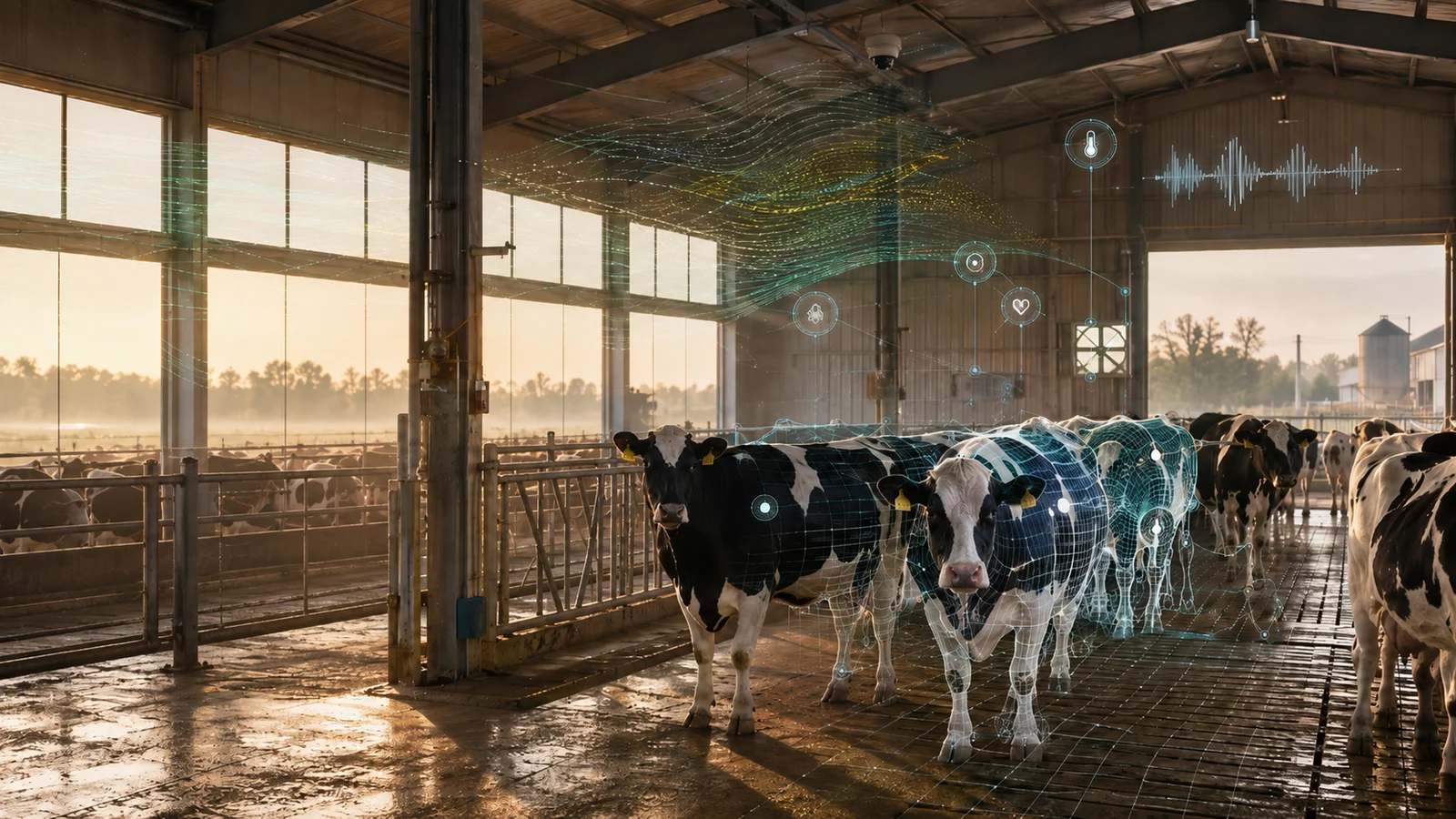
For the uninitiated, the concept of a digital twin can sound like speculative fiction. Originating decades ago in aerospace and biomedical manufacturing, a twin in the agricultural context is not merely a static digital record. It is a complex simulation powered by continuous, multi-modal data streams. In a modern research setting, cameras capture animal movement, motility, and behavioral asymmetry, such as which side of the body a dairy cow favors when lying down. Sound-recording devices pick up vocalizations, while environmental sensors track temperature and humidity. When synthesized through artificial intelligence, these heterogeneous inputs construct a virtual model capable of mimicking the physical reality of the livestock and their housing systems.
The analytical power of a digital twin lies in its predictive capacity. Traditional farm management tools are inherently reactive, displaying historical data on a screen to tell a producer what happened yesterday or an hour ago. A digital twin, by contrast, shifts operations from reactive to proactive. If a Canadian livestock producer faces a potential supply chain bottleneck for feed supplements forty-five days out, a digital twin can simulate the impact on herd health and productivity at a fraction of the cost and with zero biological risk. Similarly, calculating precise metrics like methane emissions per litre of milk or carbon dioxide output per dozen eggs involves notoriously complex formulas. Digital twins offer a holistic computational pathway to derive these figures, helping operations navigate net-zero targets and sustainability mandates with empirical precision.
Realizing this potential, however, requires confronting the fragmented nature of agricultural data. Unlike crop production, where precision agriculture has achieved widespread adoption, livestock data is notoriously siloed. Milk testing companies, wearable sensor providers, robotic milking system manufacturers, and veterinary record-keepers all operate on proprietary platforms. Without intentional interoperability, the proliferation of distinct technologies risks creating operational chaos rather than clarity. Researchers working in this space emphasize the necessity of open-source mathematical models and unified standardization protocols. If every technology provider insists on proprietary standards, the financial and operational burden on farmers becomes prohibitive. A truly effective digital twin ecosystem must be accessible to both large-scale commercial operations and small-scale producers alike, ensuring that data ownership remains firmly in the hands of the farmers and the agricultural community.
Beyond operational efficiency and supply chain resilience, the most compelling application of digital twin technology rests in animal welfare and disease mitigation. By deploying bioacoustic monitoring—listening to the vocalizations of poultry or swine—systems can assess the mental makeup and stress levels of animals before physical symptoms manifest. Small adjustments, such as modifying ventilation fan rotations by precise margins or shifting cleaning cycles by a matter of weeks, can drastically improve the resilience and recovery capacity of livestock. When disease threats like avian influenza loom, the ability of deep-learning algorithms to process massive volumes of multi-modal data within minutes rather than weeks transforms epidemiological tracking.
Ultimately, the deployment of artificial intelligence and digital twins in Canadian livestock farming challenges the traditional, transactional view of agriculture. For decades, the dominant paradigm has reduced animal husbandry to a simple inputs-and-outputs equation: feed and shelter provided in exchange for protein and yield. By introducing sophisticated simulation tools that respect the biological complexity of animals, researchers are reframing the relationship toward one of co-creation and stewardship. Technology, in this context, does not replace the intuitive, five-senses assessment of an experienced farmer walking the barn floor. Instead, it converts subjective observation into objective insight, offering a pathway where technological innovation, animal well-being, and sustainable producer profitability advance in tandem.
Related Episode
Themes
- Biological Entities and Multi-Sensory Data
- Digital Twins vs. Reactive Dashboards
- Open Source Standards and Interoperability
- From Transactional Farming to Animal Co-Creation